09/09/2026
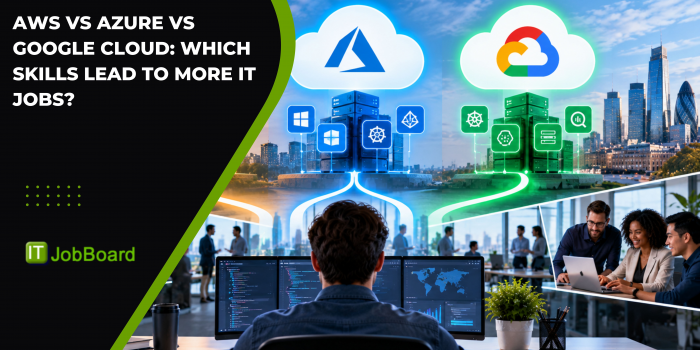
AWS vs Azure vs Google Cloud: Which Skills Lead to More IT Jobs?
Cloud candidates often ask one big question: should I learn AWS, Azure or Google Cloud first? The answer depends on your target employers, current background and career goal. This AWS vs Azure jobs guide compares platform strengths, common roles, skills and how to choose a practical learning path.
Quick Answer / TL;DR
AWS vs Azure jobs are both strong career options, while Google Cloud can be valuable for data, AI and analytics-focused roles. AWS is broad across startups, SaaS and cloud-native teams; Azure is strong in Microsoft-heavy enterprises; Google Cloud is often linked to data engineering, AI and modern analytics. Candidates should learn one platform deeply, then add portable cloud fundamentals.
Table of Contents
- AWS vs Azure vs Google Cloud: What Is the Difference?
- Do AWS vs Azure Jobs Lead to More IT Opportunities?
- AWS, Azure and Google Cloud Job Comparison
- Which Skills Transfer Across AWS Jobs and Azure Jobs?
- Which Platform Should Beginners Learn First?
- AWS vs Azure Jobs Career Path Table
- How to Build a Cloud Portfolio for AWS vs Azure Jobs
- Mistakes Candidates Make When Choosing Cloud Skills
- How to Read AWS Jobs, Azure Jobs and Google Cloud Job Posts
- Platform Learning Plan for AWS vs Azure Jobs
- When Multi-Cloud Skills Matter
- How Certifications Fit Into AWS vs Azure Jobs
- How to Decide Between AWS Jobs, Azure Jobs and Multi-Cloud Roles
- FAQ: People Also Ask About AWS vs Azure Jobs
- Key Takeaways
- Call to Action
AWS vs Azure vs Google Cloud: What Is the Difference?
AWS, Azure and Google Cloud are the three major cloud platforms employers mention in IT job postings. They all provide compute, storage, databases, networking, identity, security, analytics and AI services, but they are common in different environments.
AWS is often associated with cloud-native teams, SaaS companies and broad infrastructure roles. Azure is common in Microsoft enterprise environments using Windows Server, Active Directory, Microsoft 365 and enterprise identity. Google Cloud is often visible in data, analytics, Kubernetes and AI-heavy workflows.
Do AWS vs Azure Jobs Lead to More IT Opportunities?
AWS vs Azure jobs both lead to strong IT opportunities because many U.S. employers use one or both platforms. The better choice depends on the companies you target. If your target employers are Microsoft-heavy enterprises, Azure may be more strategic. If you want broad cloud-native infrastructure exposure, AWS may be a strong starting point.
Google Cloud should not be ignored. It can be especially useful for candidates focused on data engineering, analytics, AI platforms and Kubernetes-style infrastructure.
AWS, Azure and Google Cloud Job Comparison
|
Platform
|
Common job titles
|
Best-fit candidates
|
|
AWS
|
AWS cloud engineer, DevOps engineer, solutions architect
|
Candidates targeting SaaS, startups, cloud-native infrastructure and broad cloud roles.
|
|
Azure
|
Azure administrator, cloud engineer, identity engineer, solutions architect
|
Candidates targeting enterprises, Microsoft ecosystems and hybrid cloud.
|
|
Google Cloud
|
GCP cloud engineer, data engineer, ML platform engineer
|
Candidates targeting data, analytics, AI and Kubernetes-heavy environments.
|
|
Multi-cloud
|
Platform engineer, cloud security engineer, SRE
|
Candidates with strong fundamentals and production experience.
|
Which Skills Transfer Across AWS Jobs and Azure Jobs?
Many cloud skills transfer across platforms. Employers value candidates who understand identity, networking, compute, storage, databases, monitoring, security and automation. The console names change, but the concepts remain similar.
This is why candidates should avoid memorizing only service names. A stronger approach is to understand the architecture behind the service: how users access it, how it is secured, how it scales, how it is monitored and how it affects cost.
- Linux and command-line basics
- Networking, DNS, routing, subnets and load balancing
- Identity and access management
- Security logging and monitoring
- Infrastructure as Code and CI/CD
- Containers and Kubernetes basics
- Cost optimization and resource tagging
- Architecture documentation and stakeholder communication
Which Platform Should Beginners Learn First?
Beginners should choose one platform based on target jobs. If local postings mention AWS more often, start with AWS. If employers in your target industry run Microsoft environments, start with Azure. If your goal is data engineering or AI platform work, consider Google Cloud.
The most important rule is depth before breadth. One strong portfolio project on one platform is more valuable than shallow familiarity with three dashboards.
AWS vs Azure Jobs Career Path Table
|
Goal
|
Recommended starting platform
|
Why
|
|
General cloud engineer
|
AWS or Azure
|
Both appear frequently in cloud infrastructure roles.
|
|
Enterprise IT cloud role
|
Azure
|
Strong Microsoft identity and enterprise integration.
|
|
Startup or SaaS DevOps
|
AWS
|
Broad cloud-native and startup ecosystem usage.
|
|
Data/AI platform role
|
Google Cloud or AWS
|
Useful analytics, ML and data services.
|
|
Security role
|
Azure, AWS or multi-cloud
|
Cloud security depends more on IAM, logging and controls than one vendor.
|
How to Build a Cloud Portfolio for AWS vs Azure Jobs
- Choose one platform and create a simple web application or API.
- Add database, storage, identity and network controls.
- Automate deployment with Terraform, Bicep or CloudFormation.
- Add monitoring, logging and alerting.
- Document architecture, cost controls and security decisions.
- Create a short GitHub README that explains the business use case.
- Use the project in your resume and interviews.
Mistakes Candidates Make When Choosing Cloud Skills
- Switching platforms every month without finishing projects
- Learning only console clicks instead of architecture
- Ignoring networking and IAM fundamentals
- Collecting certifications without hands-on proof
- Assuming Google Cloud has no job value
- Applying for cloud jobs without showing troubleshooting experience
How to Read AWS Jobs, Azure Jobs and Google Cloud Job Posts
Job descriptions often reveal the real platform priority. If a post mentions Active Directory, Entra ID, Microsoft 365, Windows Server and enterprise identity, Azure skills may be central. If it mentions EC2, Lambda, ECS, EKS, CloudFormation or S3-heavy architecture, AWS may be more important. If it mentions BigQuery, Vertex AI, Dataflow or GKE, Google Cloud may be a strong fit.
Candidates should also look beyond provider names. A job that mentions Terraform, Kubernetes, CI/CD, IAM, logging and incident response may value general cloud engineering more than one specific vendor.
Platform Learning Plan for AWS vs Azure Jobs
- Choose one provider based on target job descriptions.
- Learn compute, storage, networking, IAM and monitoring first.
- Build one project that uses automation, not only manual console clicks.
- Add security controls and cost notes to the project documentation.
- Learn the equivalent services on a second provider only after finishing the first project.
When Multi-Cloud Skills Matter
Multi-cloud skills matter more at mid-level and senior levels than at the beginning. Architects, platform engineers and cloud security professionals often need to compare providers, standardize controls and support multiple environments. Beginners usually get more value from depth in one platform plus strong fundamentals.
How Certifications Fit Into AWS vs Azure Jobs
Certifications can help candidates pass resume filters for AWS jobs and Azure jobs, but they should not be the entire strategy. Employers want to know whether candidates can build, troubleshoot, secure and explain systems. A certification plus a working project is stronger than a certification alone.
Useful certification paths include AWS Solutions Architect, Azure Administrator, Azure Solutions Architect, Google Associate Cloud Engineer and Google Professional Cloud Architect. Candidates should choose certifications that match target job descriptions rather than collecting random badges.
How to Decide Between AWS Jobs, Azure Jobs and Multi-Cloud Roles
The best decision comes from market research. Candidates should collect twenty job postings in their target location or remote category and count which platforms appear most often. If AWS appears in most postings, start there. If Azure appears with Microsoft 365, Entra ID and enterprise infrastructure, Azure may be the better first move.
Multi-cloud roles are usually better after building depth. A candidate who understands one platform well can learn equivalents faster than a candidate who memorizes shallow definitions across three platforms.
FAQ: People Also Ask About AWS vs Azure Jobs
Which is better for jobs: AWS or Azure?
Both AWS and Azure can lead to strong job opportunities. AWS may be more common in cloud-native and SaaS environments, while Azure is strong in Microsoft-heavy enterprises.
Are Google Cloud jobs worth pursuing?
Yes. Google Cloud jobs can be valuable for candidates focused on data engineering, analytics, AI and Kubernetes-related work. It may be less universal than AWS or Azure in some markets but can be strategic.
Should beginners learn AWS, Azure or Google Cloud first?
Beginners should choose based on target job postings and career goals. Learn one platform deeply, build projects and then add transferable cloud fundamentals.
Do AWS jobs pay more than Azure jobs?
Pay depends more on role, experience, location, industry and seniority than platform alone. Senior architects, DevOps engineers and cloud security roles can pay well across platforms.
Can I get cloud jobs with certifications only?
Certifications help, but most employers want practical evidence. Projects, labs, troubleshooting examples and architecture documentation make certifications more credible.
Where can I find AWS jobs and Azure jobs?
Use ITJobBoard.net to search AWS jobs, Azure jobs, Google Cloud jobs, DevOps roles, cloud security roles and cloud architect openings.
Key Takeaways
- AWS and Azure both support strong cloud career paths.
- Google Cloud is especially relevant for data, AI and analytics use cases.
- Learn one platform deeply before trying to master all three.
- Cloud fundamentals transfer across providers.
- Portfolio projects make candidates more credible than tool lists.
Related Blogs
-
-
-
-
-
-
-
-
-
-
-
-
-
-
-
-
-
-
-
-
-
-
-
-
-
-
-
-
-
-
-
Cybersecurity Jobs in the USA: Best Roles for Beginners and Professionals
-
-
-
-
-